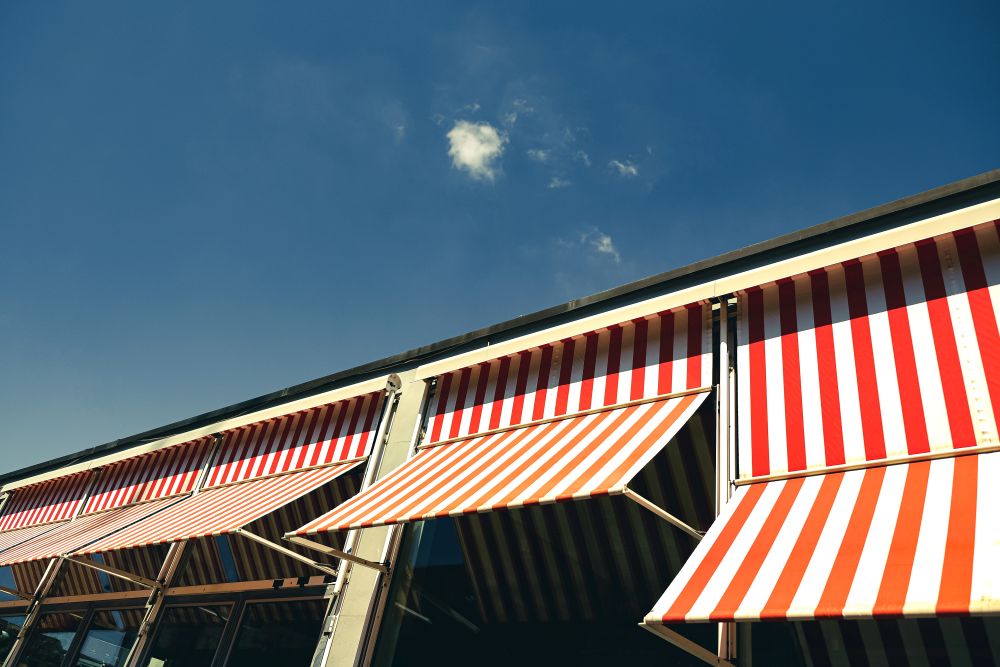
Homeowners hunting for reliable retractable awning manufacturers tend to open every conversation with the same three questions: how tough is the fabric, how quiet is the motor, and how long will the frame last in coastal air. The order matters. A house in Bukit Timah faces sun patterns that a terrace in Joo Chiat never sees, and the hardware must answer to both the equatorial heat and the salt that a south-westerly wind carries inland for miles.
Fabric comes first. The weave must shed a sudden downpour, resist mildew, and hold its colour through years of ultraviolet exposure. Solution-dyed acrylic, favoured by most Singapore workshops, absorbs pigment into every strand rather than coating the surface. When a palm frond scrapes across it in a storm, the colour stays put. Cheaper surface-printed fabrics bleach out in eighteen months.
What Good Awning Builders Get Right
A seasoned fabricator walks the client through every joint, hinge, and bolt before taking a single measurement. That is the habit of a craftsperson. The best retractable awning manufacturers in Singapore test each arm of a folding-arm unit under load for thousands of cycles, because a balcony installation in Marine Parade might extend and retract twenty times a week. A motor rated for ten thousand cycles will fail within three years on such a balcony.
Consider the motor. A reliable tubular motor runs with the murmur of a refrigerator compressor. A cheap one announces itself. When a client stands beneath an awning in a Pasir Ris showroom and cannot hear the motor over the rustle of the fabric, that is the mark of a sound build. Every respected workshop in the country insists on branded motors from Somfy or Nice, because spare parts stay available for a decade.
Key components to inspect before purchase
- Frame materials
- Marine-grade aluminium for coastal estates
- Powder-coated steel for inland bungalows
- Fabric
- Solution-dyed acrylic for fade resistance
- PVC-coated polyester for heavy rain exposure
- Motors
- Tubular motors with remote control
- Wind and sun sensors for automatic retraction
How Singapore’s Climate Shapes the Design
No other market asks as much of an outdoor awning as this one. The tropics allow no shortcut. Annual rainfall in Singapore averages 2,340 millimetres, and the sun pushes surface temperatures on a west-facing wall above 50 degrees Celsius by mid-afternoon. An awning here does the work of both a raincoat and a sunshade.
Workshops that understand this build awnings with generous projection, deeper than the European standard, to throw shade well past the facade. They set drainage slopes that shed a sudden squall off the fabric in seconds. They fit stainless fasteners rated for a coastal micro-climate. The local retractable awning manufacturers who ignore these details turn out units that sag within a single monsoon.
Lee Kuan Yew once said, “We have to get our priorities right. We have to look at the fundamentals.” That principle reads well in a workshop. The fundamentals are the fabric, the frame, and the motor, in that order.
The Singapore Workshop Difference
Local outdoor shade manufacturers know HDB regulations, condominium by-laws, and the tight service corridors common to landed properties. A visit to the fabrication floor at a Toh Guan unit tells the story. Technicians cut fabric panels on long tables, stitch reinforced seams, and build the arms one at a time. Each finished awning carries a serial number stamped into the cassette.
That record matters. Five years on, when a homeowner in Sembawang rings about a torn fabric panel, the workshop pulls the original file and sends out the correct replacement in the original colour. Off-the-shelf imports rarely offer that continuity. The serial number becomes the client’s insurance policy, and any workshop that cannot produce one does not deserve the contract. A local workshop also dispatches a technician within two working days for an urgent repair, which matters when a family is hosting guests that weekend and the western sun is turning the lanai into a furnace.
Costs, Warranties, and What to Ask For
Pricing in Singapore covers a wide span. A 3-metre motorised folding-arm awning starts around S$2,500 and climbs to S$8,000 for larger installations with sensors and premium fabric. Reputable awning makers publish a clear warranty of at least five years on the frame and three years on the motor.
A sharp buyer asks specific questions:
- Is the motor a branded unit with local service agents?
- Will the workshop provide a signed site-survey report?
- Does the quote include wind-sensor wiring or only the awning?
The answers sort the serious suppliers from the rest. One Holland Village resident discovered the difference when his new installation outlived the installer’s written warranty by seven years.
Final Thoughts
When choosing among awning fabricators in Singapore, ignore the glossy brochures and ask to stand under a working unit. Listen to the motor, touch the seam, pull the fabric taut, and watch how the arm unfolds under tension. Those ninety seconds teach a buyer more than a full catalogue. Homeowners who follow that method end up with the work of the country’s most trustworthy retractable awning manufacturers.