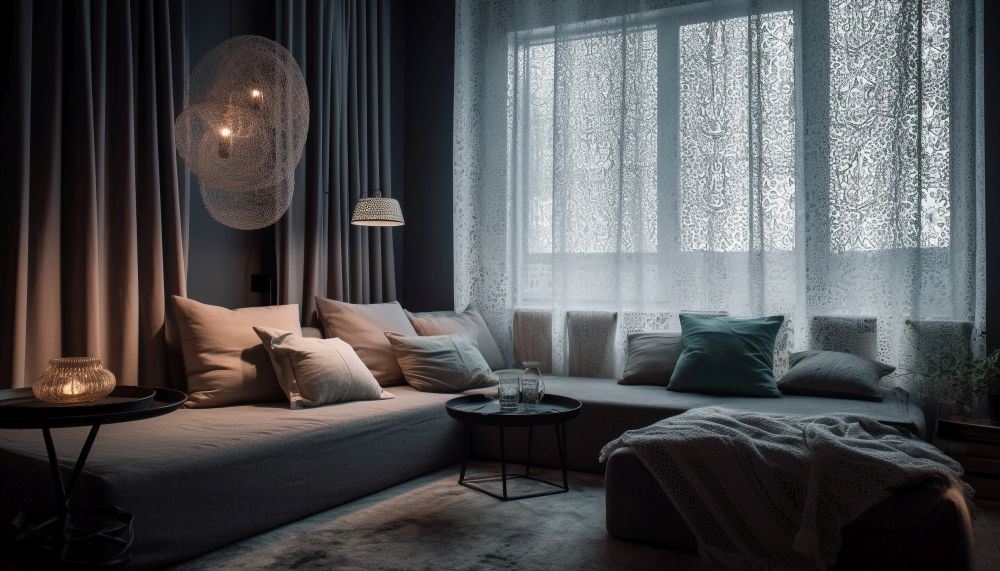
A flat facing an arterial road in Bukit Timah and a corridor unit overlooking a school field in Sengkang have very little in common, except that both households end up fighting the same two enemies every day: light that floods in far too early and noise that never really stops. Acoustic blackout curtains were designed for exactly this kind of home, where ordinary drapes handle neither problem well. They combine a dense, sound-dampening backing with a light-blocking lining, and the result shows up less as a single dramatic change and more as a string of small, daily improvements that add up over a few weeks of living with them. The appeal isn’t really about a single feature but about how two ordinary annoyances, tackled together, change the way a room feels at almost every hour of the day.
The Noise That Never Gets Mentioned
Most people underestimate how much low-level sound wears them down until it’s gone. Lift motors, air-conditioning compressors on the neighbouring block, late-night conversations drifting up from the void deck, delivery riders idling outside a landed property gate none of it is loud enough to complain about, but all of it interrupts concentration and light sleep. Acoustic curtains work by trapping and dispersing sound waves within their layered fabric rather than letting them bounce straight through a single thin panel, which is why the difference is most obvious in quieter moments: reading in the evening, working from a home desk, or lying awake at 2am when a lorry rumbles past.
Heat Gain Is a Bigger Issue in Singapore Than People Admit
Blackout lining wasn’t originally designed for the tropics, but it does double duty here because it also blocks a large share of solar heat before it hits the glass. A west-facing unit in the late afternoon can turn a living room into something close to a greenhouse, and standard sheers barely slow that down. Thicker, lined acoustic curtains cut glare and reduce how hard the air-conditioning has to work to bring a room back to a comfortable temperature, which matters in a climate where units often run for hours at a stretch regardless of the season.
Fitting Them Into a Room That Already Has Curtains
Many homeowners don’t replace their existing curtains outright; they add acoustic blackout panels as an inner layer, keeping a lighter sheer or decorative curtain on the outer track for daytime use and drawing the acoustic layer closed at night or during nap times. Suppliers who specialise in acoustic curtains for Singapore homes usually offer this dual-track setup as a standard configuration, since it lets a household keep the aesthetic they already like while adding the functional layer only where it’s needed, such as a bedroom or a home office that doubles as a study.
Where the Weight of the Fabric Actually Matters
The trade-off with any acoustic or blackout fabric is weight. A denser weave blocks more but pulls harder on a track and needs a sturdier rod or motorised system to glide smoothly, particularly on wider windows common in newer condo units with floor-to-ceiling glass. Getting this measured and specified correctly before ordering avoids the common complaint of curtains that sag in the middle or stick when drawn, which undermines the whole point of installing them.
Rooms Where the Difference Shows Up First
Bedrooms along an expressway or near an MRT viaduct benefit the most obviously, but home offices are a close second, especially for anyone taking calls where background noise bleeding through a window becomes distracting for the other person on the line. Children’s rooms are another practical case afternoon naps get disrupted less by sunlight, and the added mass of the fabric takes the edge off noise from siblings or a television in the next room.
Getting the Fit Right From the Start
Comfort gains from acoustic blackout curtains depend heavily on installation details that are easy to overlook: full-width coverage past the window frame, proper overlap where two panels meet in the middle, and a pelmet or box at the top to stop light leaking over the rail. A curtain that’s technically the right fabric but poorly fitted will still let in a strip of morning sun or a sliver of hallway noise, which defeats much of the purpose.
Colour and Texture Don’t Have to Suffer
A common assumption is that adding acoustic backing and blackout lining means settling for a heavy, plain-looking curtain, but the lining sits behind the decorative face fabric rather than replacing it, so the visible side can still be a linen weave, a soft velvet, or a printed cotton chosen purely for how it looks in the room. The performance layers stay hidden once the curtain is hung, which is why acoustic blackout curtains have moved well beyond utilitarian bedrooms into living rooms and dining areas, where appearance carries just as much weight as function and nobody wants a window treatment that looks like it belongs in a recording studio.
Comfort at home is rarely one big fix it’s a collection of small frictions removed, and acoustic blackout curtains address two of the most persistent ones at once. For households in noisy or sun-exposed units, the change is usually felt within the first few nights, long before anyone consciously notices the fabric doing its job, and it tends to be the small routines an uninterrupted afternoon nap, a call taken without apologising for background noise that end up being the clearest proof it was worth doing.